
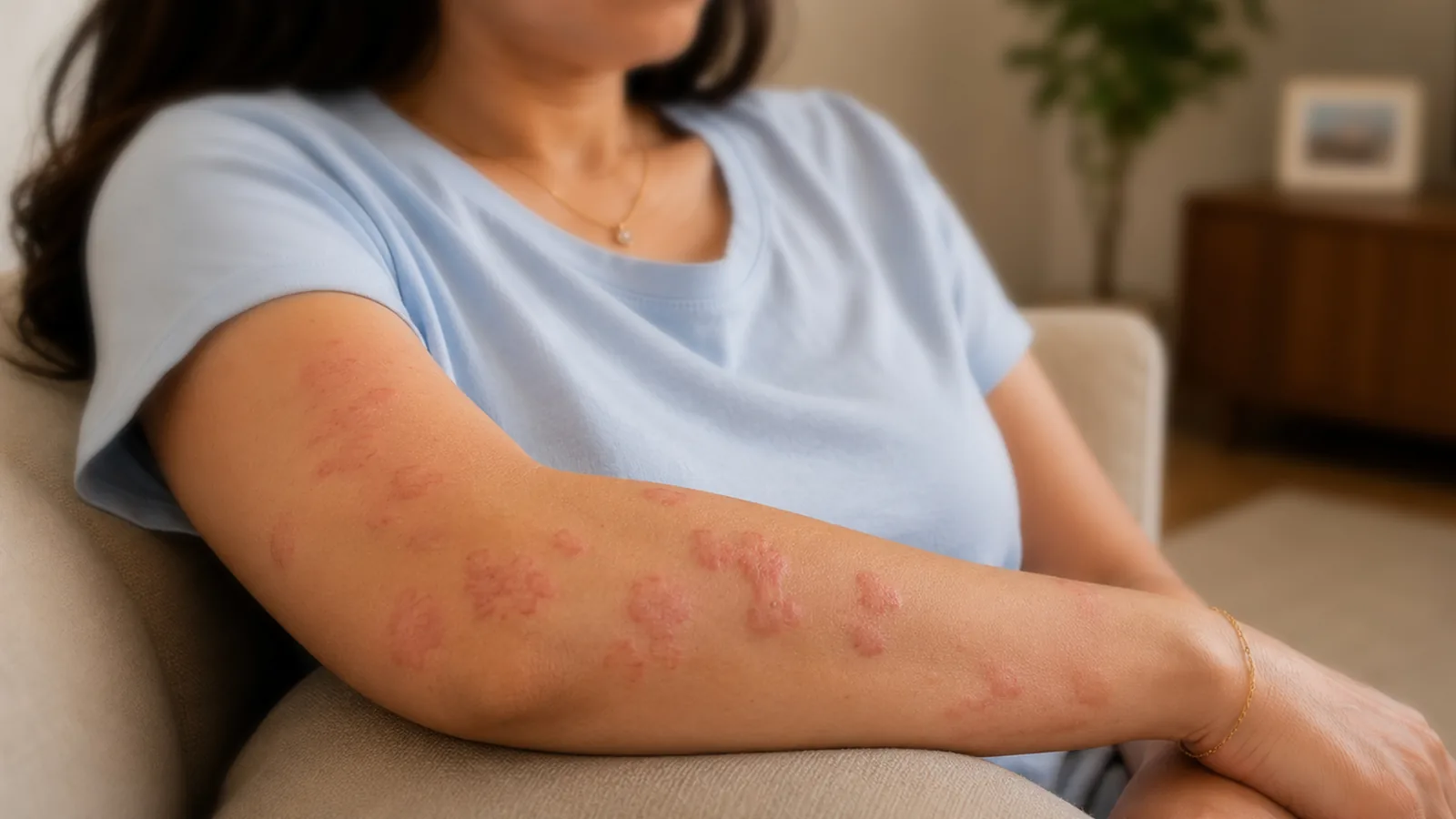
It’s an ordinary night. You’ve eaten dinner, scrolled through your phone, maybe watched an episode before bed. Nothing unusual about the day.
Then the itch wakes you up before the hives even show. You scratch in the dark, half-asleep, and by morning, your arms are covered in welts. You can’t go to work like this, so you grab whatever antihistamine is in the medicine cabinet and hope it holds.
It does, for a while. But you spend the day running through what could have caused it anyway: the shrimp from lunch yesterday, the heat on your commute, that new lotion your friend gave you last week. Something must have triggered this. You cut it out. You wait.
Then the itch comes back, worse this time, and you’re standing in a pharmacy at 9 pm buying something stronger because you can’t afford to lose another night of sleep.
Weeks of this. Maybe months. You’ve seen a doctor, maybe two, and both times you walked out with a prescription and a “let’s just monitor it.” Nobody told you this could cost you sleep, focus at work, money on medication you end up buying on your own. Nobody told you it could last this long.
It may not be an allergy at all. For many Filipinos living with recurring hives, the real issue is a chronic skin condition called Chronic Spontaneous Urticaria, or CSU. Most people have never heard of it, and that’s a big part of why so many end up stuck in the same cycle for so long.
What is CSU?
Chronic Spontaneous Urticaria is a skin condition where hives, and sometimes swelling, appear repeatedly with no identifiable external trigger, for six weeks or longer.[1][2] It’s not a rash that flares up once and resolves. It’s a condition that keeps coming back, often unpredictably, over months or even years.
The word “spontaneous” is the key distinction. The immune cells responsible for itching and hive formation fire on their own, without an external cause setting them off. This is why flare-ups can happen at any time: during sleep, on an ordinary workday, on a day when you’ve eaten the same things you always eat and done nothing differently. There’s no moment you can point to and say, that’s what caused it.
CSU isn’t caused by food, poor hygiene, or anything contagious. It’s also more common than most people realize, particularly in Asia. Research shows chronic urticaria affects around 1.4% of Asian populations, higher than figures seen in Europe and North America, with women more commonly affected than men.[3] Many go through multiple consultations before anyone identifies what they’re dealing with.
CSU vs. allergic hives: what’s actually different
On the skin, the two can look exactly the same: raised, red, itchy. The difference isn’t visible. It’s in how each one works.
The logic behind allergic hives is straightforward. The immune system encounters something it’s sensitive to: a food, a substance, something in the environment, and reacts. Where a specific allergy is identified, removing that trigger settles the reaction, sometimes within a day.[2] That framework is intuitive, and it’s the one most people are working from when they start cutting things out and switching products.
CSU works completely differently. There is no external trigger. The immune response comes from within, which means there’s nothing to identify and nothing to remove. Allergic hives follow a cause-and-effect pattern. CSU follows no pattern at all. Flare-ups appear at random, ease up, and return without any clear reason.
This is why tracking and eliminating don’t work for CSU. It’s not that the person hasn’t been careful or thorough enough. The trigger simply isn’t there to be found. Without knowing that, it’s easy to keep looking indefinitely, blaming the wrong things, questioning your own memory, wondering what you’re missing.
That difference, internal versus external, spontaneous versus triggered, changes everything about how the condition needs to be managed.[4][5]
If you’ve been tracking your flare-ups and nothing adds up, that experience is already medically significant.
Break the I.T.C.H.When do recurring hives become a medical concern?
Most people assume hives are temporary. Something to manage for a few days until whatever caused them clears the system. For acute urticaria, that’s often true: it lasts six weeks or less, it often follows something identifiable like a recent infection, and it usually settles without a full diagnostic workup.[2]
CSU is defined by a different timeline. Six weeks is the clinical threshold: flare-ups occurring on most days, for six weeks or longer, with no identifiable trigger.[1] Once hives cross that line, they’re no longer something to wait out. They’re pointing to something that needs a proper name and a proper approach.
If you’ve been tracking your flare-ups and nothing adds up, no consistent trigger, no lasting relief, no clear explanation, that experience is already medically significant. It’s enough to bring it to your doctor and ask directly whether this could be CSU. You don’t need a confirmed diagnosis before that conversation. What you’ve been going through is already the starting point.
How CSU is diagnosed
One of the more frustrating things about CSU is that there’s no single test that confirms it. No blood panel, no skin test, no result that comes back with a definitive answer. The diagnosis is built by putting together a clear picture of what you’ve been experiencing over time.[2]
Your doctor will ask about your history: how often flare-ups occur, how long they last, what you’ve tried, and whether any consistent trigger has ever been identified. A detailed history is the first step in diagnosing any form of urticaria, followed by a physical examination and a limited set of basic blood tests.[2] The tests are there to rule things out, not to confirm CSU directly.
Because hives come and go, they may have faded by the time you’re actually in the clinic. Photos of your flare-ups on your phone count as part of your medical record, and guidelines specifically recommend that doctors review patient-taken photographs of hives or swelling.[2] Taking a quick photo whenever a flare-up appears, even a blurry one at 2 am, gives your doctor something concrete to work from.
Describing your experience clearly matters more here than in most consultations. The more specific you can be, when it started, how frequently it happens, how long each episode lasts, what’s made it better or worse, the clearer that picture becomes. If you’re not sure how to organize all of that before your appointment, our Consultation Checklist walks you through exactly what to cover.
What happens when antihistamines aren’t enough
Most people with CSU have already spent time on antihistamines before anyone uses the word CSU. Antihistamines do help. They work by acting on the H1 receptor, holding it in its inactive state so that histamine, one of the main chemicals behind itching and hive formation, has less of an effect.[2] The problem isn’t that they don’t work at all. It’s that they work on the symptom while the underlying condition continues.
In allergic hives, reducing histamine addresses the reaction because the trigger has been removed. In CSU there is no trigger to remove, so the response to antihistamines varies from person to person.[2][5] Some people find relief at a standard dose. Others need more before symptoms settle, and some notice little change at first.
That variation is expected, and treatment guidelines are built around it. International guidelines recommend second-generation antihistamine as the first step for all types of urticaria. If symptoms are still not controlled at the standard dose, the next step is raising that same antihistamine up to four times the standard dose under a doctor’s supervision. If symptoms continue, treatments beyond antihistamines are added.[2] Guidelines also describe stepping the dose back down once symptoms have settled for a few months, and periods of full remission are part of how this condition is expected to behave.[2]
Each of those steps is part of a plan. Moving to the next one means your doctor has enough information to adjust, not that anything went wrong earlier. Because the higher doses are prescribed and monitored, this is not something to work out on your own: taking more of whatever is in the medicine cabinet is not the same as a supervised step-up.[2]
In real-world surveys, most people with CSU had switched or up-dosed antihistamines and were still not fully controlled,[6] which is part of why there are now more treatment options than there were even a few years ago, well beyond first-line antihistamines.[2][5] Knowing that those steps exist is what makes the conversation with your doctor worth having.
It’s also common in the Philippines to see several general practitioners before reaching a specialist.[7] Each consultation without a clear answer can feel like another dead end. But if that’s been your experience, it may simply be that the right question hasn’t come up yet: whether what you’re dealing with could be CSU.
Frequently asked questions
What is CSU?
Chronic Spontaneous Urticaria is a chronic skin condition where hives appear repeatedly with no clear external trigger for six weeks or longer. Unlike allergic hives, it has no identifiable cause. The immune system reacts on its own, which is what makes it difficult to manage with standard allergy approaches.[1][2]
How do I know if my hives are CSU or something else?
Duration, frequency, and the absence of a consistent trigger are the main indicators. Hives that keep coming back on most days for six weeks or more, with no clear cause, are worth discussing with your doctor as possible CSU symptoms. Keeping a simple log of when flare-ups happen and how long they last can make that conversation more productive.
Can CSU go away on its own?
CSU doesn’t resolve the same way a one-time allergic reaction does, which is why proper management matters. Symptoms can settle for long stretches, and guidelines describe full remission as something that can happen, though flare-ups may return after months or years.[2] The right chronic urticaria treatment can significantly improve quality of life while you’re working toward longer-term answers.
Is CSU dangerous?
CSU isn’t life-threatening in most cases.[1] Some patients also experience angioedema, a sudden swelling deeper in the skin. It tends to tingle, burn, or feel tight or painful rather than itchy, and it clears more slowly than hives, sometimes taking up to three days.[2] In one large European survey, around a quarter of people with CSU reported angioedema within the past three months.[1] If that happens, seek medical attention promptly.
Is CSU an autoimmune disease?
In many patients, yes. The immune system produces antibodies that activate the cells responsible for hive formation, which is why CSU behaves so differently from a standard allergic reaction and often needs a different chronic urticaria treatment approach.[2][5]
What should I tell my doctor if I think I have CSU?
Be specific: how long the flare-ups have been happening, how often, how long each one lasts, and what you’ve already tried. Bringing photos of your flare-ups helps, especially if your skin looks clear by the time of the appointment.[2] Letting your doctor know the hives keep returning despite your best efforts, and asking directly whether CSU could be behind it, gives the conversation a much clearer direction.[7]
If your hives keep coming back
You’ve tried the antihistamines. You’ve done the elimination diet. You’ve avoided every suspected trigger you could think of. And still, the hives return.
That’s worth taking seriously.
CSU has a name. It has a recognized mechanism. And it has a treatment pathway that goes well beyond the first prescription you were handed.[2][5]
FA-11779373 – SEP2026-SEP2028
Bring your story into focus.
Our two-minute symptom checker helps you describe your pattern clearly, in your own words, before your next consultation.
Take the Symptom Checker