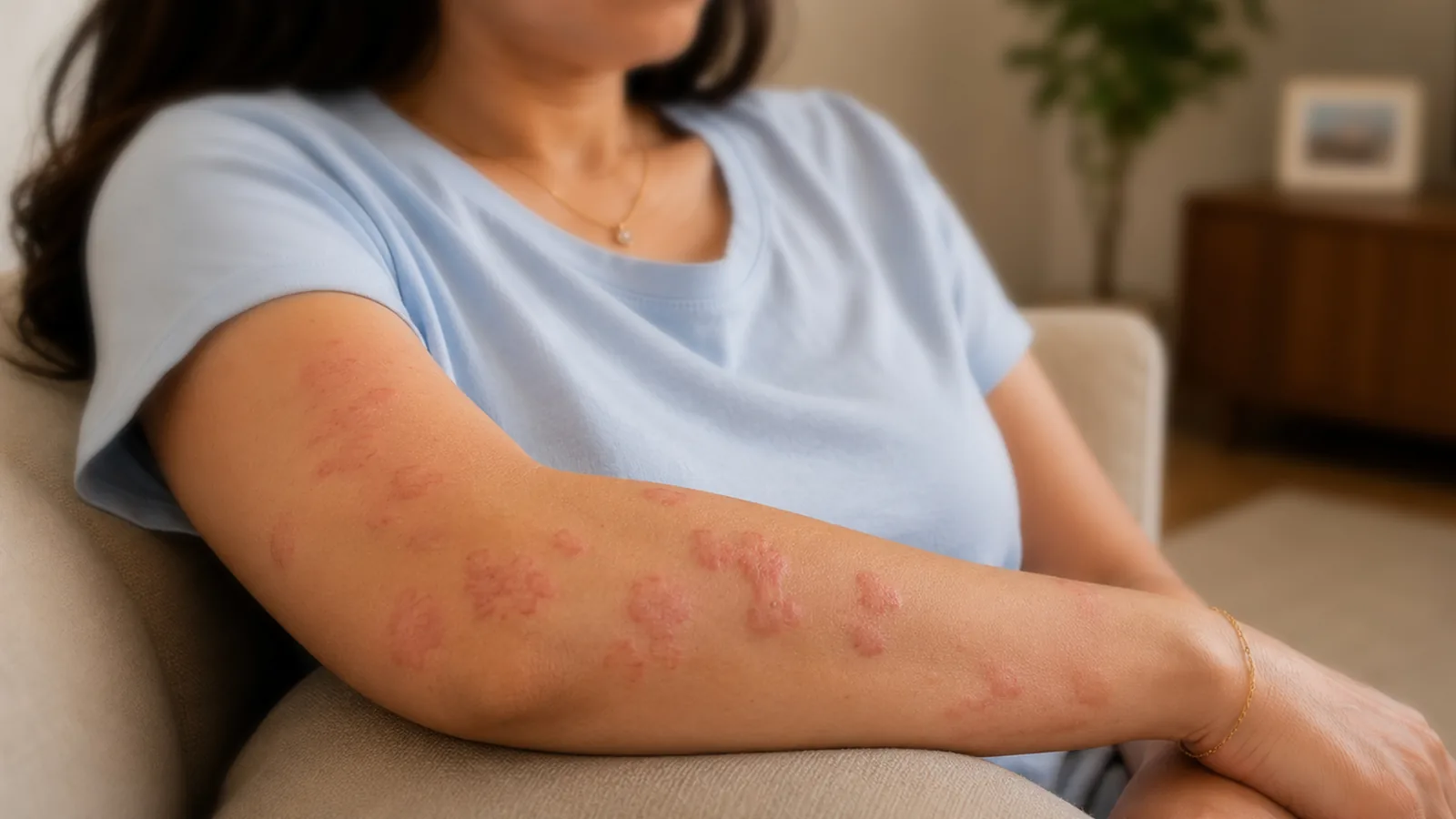

There is a moment, often, when someone living with chronic hives realizes how much they have given up without meaning to.It might come while scrolling through old photos and noticing the last time you wore that shirt was over a year ago. It might come during a conversation with a friend who asks, casually, why you never come to their get-togethers anymore. It might come while getting ready for work in the morning, when you catch yourself doing a full-body check in the mirror before you decide what to wear. There’s nothing dramatic about any of it. But over months, these moments start to accumulate.
Chronic spontaneous urticaria (CSU) is a chronic skin condition defined by recurring hives, angioedema (a sudden swelling deeper in the skin), or both, lasting more than six weeks with no identifiable external trigger.[1][4] Most conversations about it focus on the visible part: the welts, the swelling, the itch, the medication. What gets discussed far less is everything else the condition takes: the sleep, the social ease, the easy trust you used to have in your own body.
For Filipinos, this cost adds up in specific ways. Skipping a cousin’s despedida because your skin is flaring. Sitting through a meeting distracted because you barely slept. Answering “okay lang” when someone asks how you’re doing, because the truer answer feels too complicated to explain, and because you’re not sure they’d know what to do with it.
This article is about the part of CSU that a skin exam doesn’t capture, and why it deserves the same attention as the physical symptoms it comes with.
What daily life with CSU actually looks like
The word “chronic” does a lot of work in a doctor’s office. In real life, it does more.
Living with CSU means the condition sits as a background variable in almost every decision you make. What you wear. Whether you commit to an event a week in advance. How much sleep you got the night before. Whether you have your antihistamine in your bag. Over time, these adjustments stop feeling like adjustments and start feeling like the way things are.
The data reflects this. CSU patients report substantial impairment in health-related quality of life, mental well-being, and work productivity.[1] Dermatology-specific quality of life scores in this group fall in the range associated with a large or extremely large impact on daily functioning.[1] In a multi-country patient survey, the emotional burden of the condition was consistent across patients regardless of how long they had been living with it or how well their symptoms were managed.[2] The disruption becomes part of daily functioning, whether or not the patient names it out loud.
For many Filipino patients, the harder part isn’t just the physical symptoms. It’s the sense that no one around you fully understands what the condition is like. In the same multi-country survey, patients described a specific kind of isolation: feeling that people did not truly grasp the extent of their suffering.[2] That resonates in a Filipino context, where everyone in your life tends to have a theory. Baka may pagkain kang kinain. Baka stress lang. Subukan mo yung ganito. The advice is well-meaning, but it lands on someone who has already tried most of it and who is running out of ways to explain why it isn’t that simple.
How chronic hives disrupt sleep
Ask someone with CSU what the hardest part is, and the answer is often sleep.
Itching and hives frequently intensify in the evening and overnight, which cuts into both falling asleep and staying asleep. Sleep difficulties are among the commonly reported comorbidities of CSU, alongside anxiety and depression.[1][2] Over weeks and months, the fatigue becomes ambient. It follows people into work meetings, into weekend plans, into relationships at home.
The effect is bigger than tiredness. When sleep is chronically disrupted, mood, concentration, and the capacity to cope with discomfort all take a hit. A lot of what patients experience as being “on edge” or “unable to focus” isn’t a personality change. It’s what happens when the body hasn’t been given proper rest for a long stretch, and the condition isn’t letting up.
Patients with CSU report notably higher rates of sleep disturbance than the general population, and this pattern holds across different health systems, from European survey data to regional data from the Asia-Pacific.[1][3] If you have been told your exhaustion is just stress, it may be more accurate to say the exhaustion is what happens when a chronic skin condition keeps interrupting the hours your body needs to recover.
The anxiety of living with unpredictable hives
Some chronic conditions come with warning signs. You feel a migraine building. You notice the joint stiffness before the flare. CSU rarely offers that courtesy.
Hives can appear in the middle of a work presentation, during a birthday dinner, or on the morning of an event you have been looking forward to for months. There is often no clear reason. This is what the “spontaneous” in Chronic Spontaneous Urticaria actually refers to.[1] It’s also what makes the condition so mentally exhausting.
In one of the largest real-world surveys of CSU patients, stress connected to the unpredictable nature of the disease was consistently reported, regardless of whether symptoms were well managed.[2] Over time, this creates a specific kind of vigilance: mentally checking rooms for potential triggers, keeping medication close, thinking twice before committing to plans. This is not overthinking. It is a reasonable response to a condition that behaves unreliably, and it is one of the factors that a skin exam does not measure.
Is CSU your fault? Why self-blame is so common
When a condition doesn’t have a clear cause, people tend to look inward.
Many Filipino patients spend months on elimination diets: cutting out shrimp, dairy, chicken, or whatever else feels like a plausible suspect. Others rework their sleep schedules, cut back on stress, or try to be more disciplined in their lifestyle. When the hives return anyway, the natural conclusion is often that they haven’t tried hard enough yet.
The problem is that CSU, by definition, has no identifiable external trigger.[1] The immune system reacts on its own, without a food, environmental, or lifestyle cause behind it.[4] That’s part of why standard antihistamines and trigger-avoidance strategies often fall short, and why the usual “figure out what you’re reacting to” advice doesn’t hold up here. (Our previous article, Why Antihistamines Don’t Always Work for CSU Patients (opens in a new tab), covers this in detail.)
This is worth naming clearly, because the “kaya mo yan” attitude that gets Filipinos through most difficulties can work against you here. There is no willpower solution to CSU, and no discipline threshold you can reach that will make it stop. What you can do is stop treating it as a personal shortcoming, and start treating it as what it is: a medical condition that responds to medical management.
The emotional weight of CSU is not just a personal experience to endure. It has clinical consequences, and it belongs in the conversation with your doctor.
Break the I.T.C.H.When emotional impact becomes a medical concern
Here is the part that often gets missed: the emotional weight of CSU is not just a personal experience to endure. It has clinical consequences, and it belongs in the conversation with your doctor.
The numbers are worth pausing on. Among patients with CSU, anxiety symptoms were reported in 72.4% and depression symptoms in 75.7%, against 39.6% and 45.1% in the wider survey population.[1] In the Asia-Pacific region, more than half of CSU patients report symptoms of anxiety, and about a quarter report depressive symptoms.[3] These aren’t personality traits. They track living with a chronic, unpredictable condition that affects sleep, work, and social functioning.
International clinical guidance for CSU includes quality of life as a core dimension of assessment, alongside disease activity and control.[4] In practice, this means your doctor’s job includes understanding not just how often the hives appear, but how they are affecting your sleep, your mood, your work, and your ability to move through your day. This information can change what treatment looks like and how urgently to escalate it.
You are allowed to bring this up in a consultation. More than that, you are supposed to. If you have been holding back because it feels like a complaint on top of a complaint, it isn’t. It’s clinical data. If you need a framework on how to raise it, see this article on how to prepare for a consultation (opens in a new tab).
What recovery from CSU actually looks like
Recovery from CSU is not only about the hives clearing. That matters, and it is the goal of treatment. But the parts of yourself that a chronic condition has been using up also need attention: the confidence to make plans, the ease of being in your own body, the mental space that has been going toward monitoring and managing.
In one large real-world survey, 84% of people with CSU had inadequately controlled disease despite antihistamine treatment.[2] If your current treatment is not doing enough, that is not a personal failing, and it does not mean you have run out of options. It usually means the condition needs a more targeted approach, and the way to get there is a conversation with your doctor about escalation or referral to a specialist.
If you have been carrying this alone, this is where it stops. Bring the full picture to your next appointment: the hives, the sleep, the mood, the days you have lost. If you are still working out whether what you have is CSU or something else, it helps to start by understanding how chronic hives differ from ordinary allergic reactions (opens in a new tab). If your last consultation left you feeling unheard, there is a way to structure your next one so it doesn’t (opens in a new tab). And if the antihistamines that used to help have stopped feeling like enough, there is a clinical reason for that, and there are options beyond them (opens in a new tab).
Getting the physical dimension of CSU properly managed is often the point at which the rest of what you have been carrying starts to lift.
Frequently asked questions
Can chronic hives cause anxiety and depression?
Rates of anxiety and depression among CSU patients are significantly higher than in the wider survey population.[1] The unpredictability of the condition, disrupted sleep, and the ongoing uncertainty of living with a condition that comes and goes without warning all contribute. These are recognized clinical features of living with CSU, not a matter of personal disposition.
Does stress make CSU worse?
Many CSU patients report stress in connection with their condition, particularly stress tied to the unpredictable nature of flares.[2] Whether stress directly triggers flares is not fully established. What is clear is that CSU and psychological distress often show up together, which is one reason managing the condition should include a conversation about how it is affecting your wellbeing, not only your skin.
Why do chronic hives affect sleep so much?
Hives and itching often intensify in the evening and overnight, which disrupts both falling asleep and staying asleep. Sleep difficulty is among the most commonly reported comorbidities among CSU patients across countries.[1][3] The resulting sleep deprivation compounds fatigue, mood changes, and reduced ability to cope with the condition during the day.
Is it normal to feel anxious about when the next flare will happen?
Yes. The spontaneous nature of CSU (flares appearing without warning) is one of the aspects patients most consistently describe as stressful, regardless of how well managed their symptoms are.[2] If this anxiety is significantly affecting your daily life, it is worth raising with your doctor alongside your physical symptoms.
Should I tell my doctor that CSU is affecting my mental health?
Yes. Quality of life, including impact on sleep, mood, and social functioning, is a recognized part of CSU assessment in clinical guidance.[4] Being specific about how CSU is affecting your wellbeing helps your doctor see the full picture and decide on appropriate management.
FA-11779373 – SEP2026-SEP2028
Bring the full picture, not just the hives.
The Consultation Checklist helps you put the sleep, the mood, and the daily cost into words your doctor can act on.
Open the Consultation Checklist